Your Cart is Empty



Updated July 2026
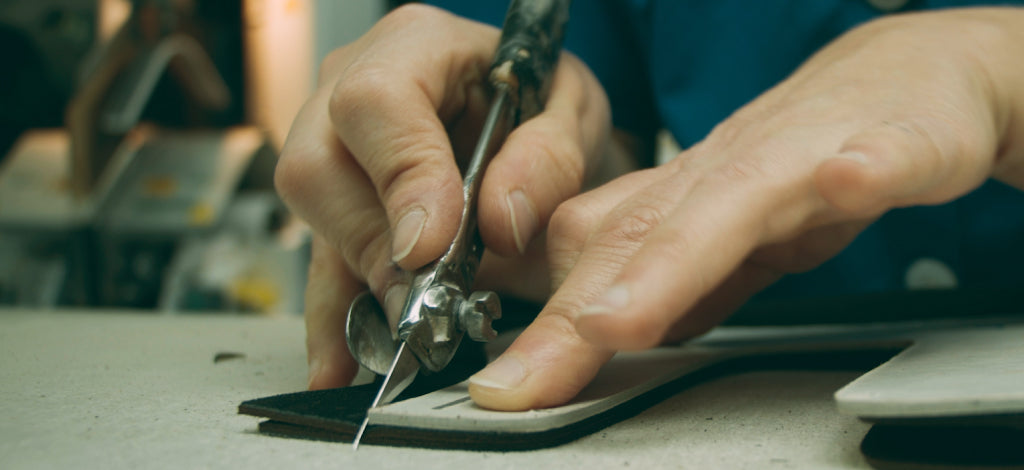
Goodyear welted is a category of high quality shoe construction that allows a pair to be resoled multiple times without damaging the upper leather. The machinery used in the process was invented in 1869 by Charles Goodyear Jr., the son of the American manufacturing engineer Charles Goodyear. Labor and material intensive, we build every pair Goodyear welted, by our artisans, one pair at a time.
How to tell if a shoe is Goodyear welted.
Why Goodyear-welt construction is better.
All about the Goodyear welt construction: Stitching, soles, leathers & more.
Goodyear welted vs Blake stitched
Types of Goodyear-welt footwear: Oxfords, derbies, loafers, monks & boots.
Price & Quality.
What hand-welting is — and whether it beats Goodyear welt.
Hand-welted vs Goodyear vs Blake vs cemented: the full comparison.
Which construction to buy for daily office wear.
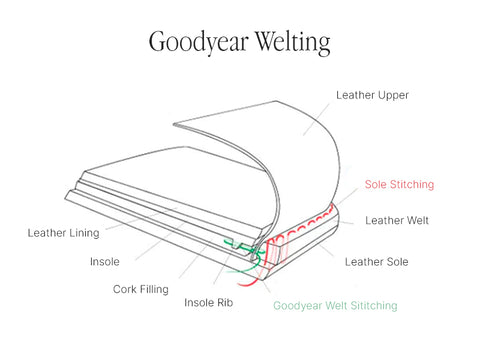
Goodyear welted shoes are made by first attaching a welt, a thin piece of leather or rubber, to the bottom edge of the upper leathers. Both pieces are further attached to a canvas rib that is cemented to the bottom of the insole.
The rib leaves a small cavity that’s filled with cork to give a breathable and malleable footbed, and a metal shank is placed at the heel to maintain the shoe’s shape. With the welt fully secured between the upper leather and insole, the outsole can finally be stitched onto the welt for a fully constructed pair.

The telltale sign when determining if a pair is Goodyear welted is the stitching between the top of the welt and the outsole. Because this is a single thread that attaches these pieces together, the stitch should be consistently finished on both sides.
Some brands glue on a welt and give it an aesthetic stitching. The intention is to give the appearance of a Goodyear welted construction, but the welt and outsole will be cemented instead of stitched. By comparing the density of stitching on the outsole with the stitching on top of the welt, an inconsistent amount of stitching is a sign that the pair isn’t truly Goodyear welted.
The Goodyear welted construction is what separates a dress shoe built to last from one built to be replaced. The primary benefit is a pair’s long term durability and ability to be resoled. Goodyear welting allows for the easy release of the outsole from the welt, which can be replaced with a brand new sole.
Because of the layers of leather stitched together, a Goodyear welted pair has greater water protection than other constructions as well. This can be further improved by including extra waterproofing elements, such a storm or norwegian welt.
There’s also the benefit of comfort over time. The construction leaves a cavity between the insole and outsole that’s filled with a layer of cork. Cork is porous and malleable, and with time will conform to the shape of the wearer’s foot for a customized fit.

The upper leathers will bend and form to match the wearer’s gait as well, reaching a level of supple strength that only real leather can provide.
Finally, it lets us create a pair that celebrates all the best aspects of shoemaking: the highest quality leathers, sustainable products that are made to last, and the hard work of real artisans that have dedicated their lives to creating beautiful things.


See The Goodyear Welted Collection
The Goodyear welted construction is the difference between spending $150 a year on a pair that is sent to a landfill when the soles break down and investing in a piece of handcrafted footwear that can be kept for decades with proper care.
When we talk about handcraft shoemaking, materials are key. The sole, the leather, and especially the welting make this footwear unique.
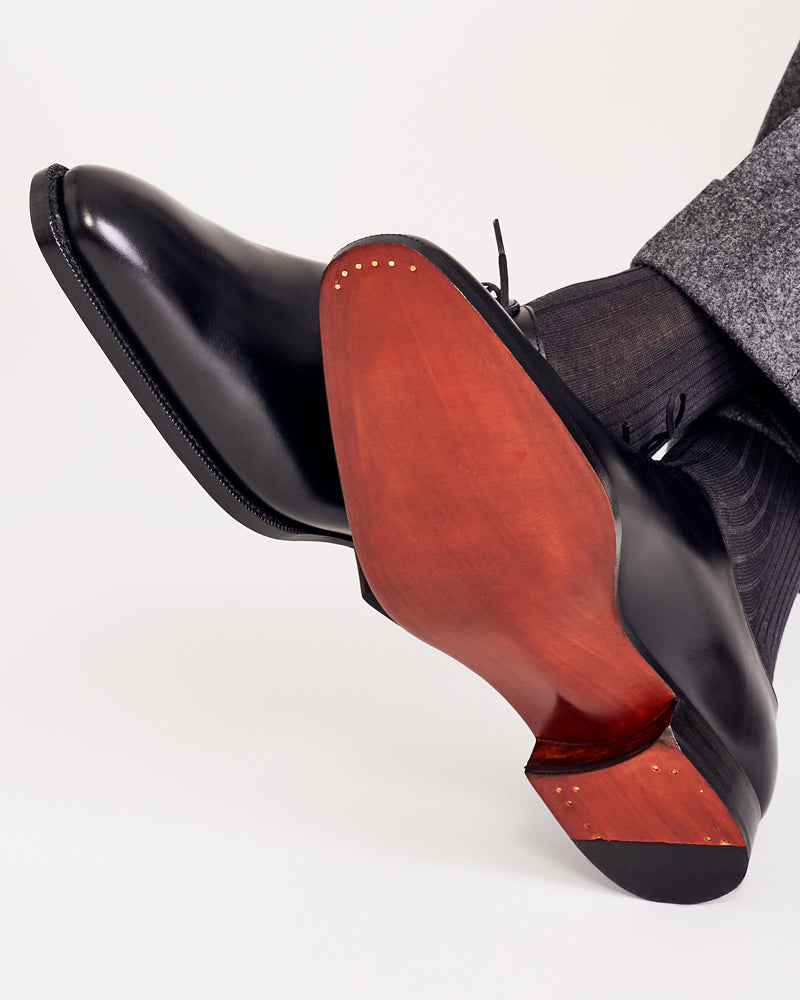
A Goodyear welted sole can be made of different materials depending on the purpose of the shoe. Goodyear welted dress shoes for formal or business wear will often use leather soles. These soles are classic, low-profile, and make a sophisticated impact that’s difficult to replace with rubber soles.
In the following article we explain all about leather and rubber soles: durability, elegance, comfort, weight and more.
We hand finish ours with a polishing dye for an extra touch of elegance. On the first wear, leather soles are very smooth and can lack grip. However, even a single day of use will wear in the soles enough to provide greater friction and traction moving forward.

Pairs for more day-to-day wear, such as Goodyear welted chukka boots, will more often use rubber soles for extra traction and durability. High density rubber soles have exceptional durability and grip for more intense wear. A rubber sole can also tone down a leather shoe to make it more casual and easier to wear with your daily jeans or chinos. We primarily use Vibram and Dainite rubber soles in our collection, rubber brands that are renowned and trusted in the shoe world for dependable quality.
The greatest benefit to this construction is the ability to resole a pair and keep them in your collection for many years to come. For that reason, the best Goodyear welted shoes will invest in using higher quality leathers that will age gracefully, patina, and stand the test of time.

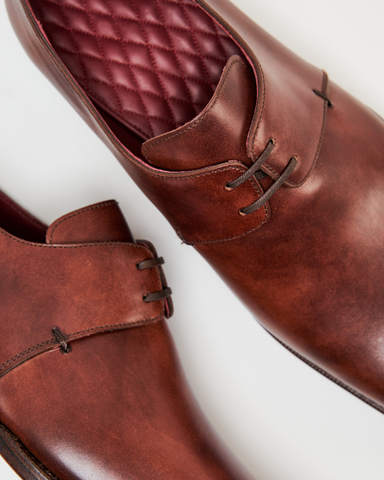
We only use full-grain leathers from the most renowned European tanneries in our pairs. Full-grain leather is the strongest and highest quality leather available, coming directly from the hide of the animal.
The benefits are a porous leather that builds character over time while maintaining the strength and durability of the original hide. Shoemakers using cheaper alternatives will use sanded then corrected hides, destroying the integrity of the leather in order to make an inferior leather presentable.
Beyond smooth and grain calf leathers, we also use full-grain reverse calf suede. Again, this means the suede hasn’t been split, sanded, or corrected, and we pick only the highest quality leathers for a velvety, natural suede that ages gracefully with time.
One of the best ways to understand the Goodyear welted construction is familiarity with other common shoe constructions.
Cementing is most common with sneakers and more cheaply constructed shoes and boots. The sole is simply glued, or cemented, to the uppers of the shoe. Since there are no extra layers of stitching or leather, the sole is immediately flexible, but once the glue fails or the sole wears down the pairs are destined for the landfill. This is acceptable for athletic sneakers but has no place in the leather shoe world.
Blake stitching is the closest relative to the Goodyear welted construction. The soles are still stitched on, but instead of attaching them to a leather welt, the stitching goes directly through the foot bed to the insole. Although this construction avoids cementing and is a bit lighter, the resulting pair is much more difficult to resole and lacks the waterproofing qualities of the Goodyear welt.
Although each construction can find a suitable place in your collection, we stand by the Goodyear welted collection as the best method in the world of shoemaking for a dependable, elegant pair that’s made to last.

Hand-welting is the oldest version of the same idea: the welt is sewn to the upper and insole entirely by hand, with an awl and waxed thread, stitch by stitch. No machine touches the seam. Instead of the canvas rib (called gemming) that machine welting attaches to the insole, a hand-welted shoe uses a ridge carved from the insole leather itself.
It is genuinely beautiful work — and genuinely slow. A single pair takes days of hand-sewing alone, which is why hand-welted shoes typically start around $1,000 and climb well past it, mostly from bespoke makers and a handful of high-end ready-to-wear houses, with waits measured in weeks or months.
Here's the part most brands skip: on your feet, the difference is small. Purists point out that a carved leather ridge is more durable than gemming, and they're right in principle. In practice, a well-made Goodyear welted shoe delivers the same silhouette, the same rebuildability, and decades of wear. Hand-welting is a craft worth admiring. It is not three times the shoe, even at three times the price.
Yes — for the right use. If you want a light, close-cut shoe for dry weather and shorter wears, Blake construction is a legitimate choice with a long tradition, especially in Italian shoemaking. If you're buying one pair to wear hard, several days a week, in whatever the sky delivers — that's welt territory.
The trade-offs are real and worth naming. The stitch channel passes through the insole, so water has a path into the shoe. Resoling is possible but requires a specific machine, and the insole tolerates fewer rebuilds than a welted shoe does. What you get in exchange is genuine: less weight, more flexibility from the first wear, and a sole trimmed close to the upper.
| Construction | How the sole is attached | Typical price | Durability & resoling | Water resistance | Best for |
|---|---|---|---|---|---|
| Hand-welted | Welt sewn entirely by hand to a carved insole ridge | $1,000+ | Decades; fully rebuildable | Excellent | Bespoke, collectors, the craft itself |
| Goodyear welted | Welt machine-stitched to upper and insole; outsole stitched to welt | $225–750 (Spain), $400–800+ (England/US) | Decades; resoled multiple times | Excellent | Daily wear, office rotation, one-shoe-does-it-all |
| Blake stitched | Outsole stitched directly through the insole | $300–800 | Good; limited resoles, needs a Blake machine | Moderate | Sleek, lightweight shoes for dry conditions |
| Cemented (glued) | Outsole glued to the upper | $50–200 | 1–3 years; not resoleable | Poor | Fashion shoes with a short intended life |
For daily office wear, the answer is Goodyear welted. Here is the reasoning, not just the verdict:
If a bespoke maker is building shoes on a last carved for your foot, hand-welting belongs in that shoe — the whole object is handwork, and you're paying for exactly that. For a rotation of shoes that work for a living, Goodyear welt is the point on the curve where construction quality and price still speak to each other. This is not the budget option. It's the rational one.
The spectrum is wide, but the Cobbler market has several classic and iconic types of Goodyear welted footwear to browse through. Let's see some differences between them.
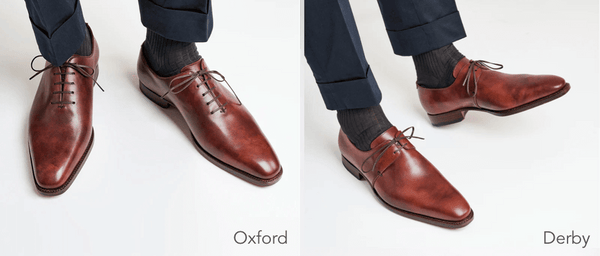
Any type of shoe can be Goodyear welted. Most laced shoes can be separated into two categories: oxfords and derbies.
Not every dress shoe laces, though. The monk strap closes with buckles instead, and it takes the same Goodyear welt as the other two.
Oxfords are among the most formal and classic designs in men's footwear. The key difference is the lacing style. Oxfords will have the perforations for lacing punched directly into the quarters on either side of the tongue. The design is minimal and elegant, and this is the shoe one most often pairs with suits and dress trousers for weddings, banquets, funerals, and other important life events.
Read this article if you want to learn more about oxford and derby differences.


The majority of our oxfords are given what’s considered a 270 degree welt. The stitching around the welt goes around the length of the waist and toe of the shoe, but stops at the heel. In this fashion, the heel is crafted more closely to the back of the shoe, providing a tighter and sleeker silhouette. The durability is maintained, and the differences are purely aesthetic.
Derbies can still be worn formally, but typically have more versatility to be worn casually through their design. Separate pieces of leather are stitched onto the quarters of the upper leather, and those flaps are given the lacing perforations. This system offers a different visual element that is best suited for day-to-day wear, business casual, or an elevated style from more casual sneakers and boots.


We make the majority of our derbies on 360 degree welts. This makes the welt stitching visible around the entire length of the shoe, including the heel. The aesthetic of this welt is a bit more classic, and the heel lip can provide some extra protection for the backside of the shoe.
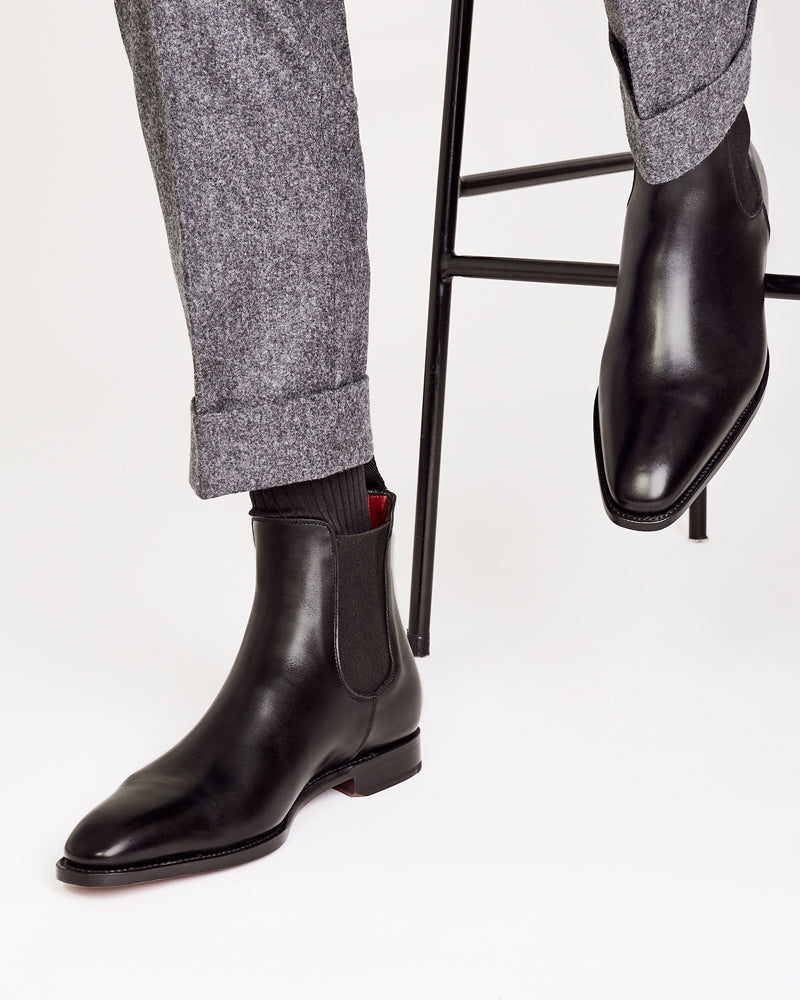
Chelsea boots are one of the most iconic boot designs in menswear. A no-fuss laceless system combined with easy versatility has made them a staple on a man’s shoe rack for decades.
Read this article if you want to learn more abouthow a Chelsea boot should fit and how to judge one.

Goodyear Welted Boots Collection
Chelsea boots are a dime-a-dozen from different shoe brands, often made with glued-on soles and inferior sanded then correct leathers. We make ours in two different shapes to fit the purpose of the wearer and accommodate different feet. Both versions are Goodyear welted with the highest quality European leathers. For pairs that are year-round styles and frequent go-to options like Chelsea boots, investing in pairs that are made to last should be at the top of your list.
A Goodyear welted loafer is another fan-favorite choice for similar reasons. They’re the quickest, easiest pair to slip on before leaving the house, and they’ve been proven classics with a storied history that goes back over a century.
Read this article if you want to learn more aboutchoosing between penny, tassel and Belgian loafers.
Goodyear Welt Loafers Collection
Many other shoemakers will offer disposable cemented options intended to replicate the look of high-quality leather loafers, or use a Blake stitch to create a light option that lacks the long term lifespan of Goodyear welted pairs.
Our loafers are built to last in penny and tassel styles, fully Goodyear welted with top grade full-grain leathers. We’ve looked to the past for classic inspiration while having an eye on relevant styles to match the needs of modern men. Balanced, effortless, and classic, a pair of Goodyear welted loafers will quickly become an everyday wear for years to come.
Because of the intensive labor and materials, the Goodyear welted process necessitates a higher production cost. Although this results in a cost higher than a cemented sole, the benefits of longevity and quality no doubt outweigh the initial investment over time. When you put a disposable pair of shoes next to an artisan-made Goodyear welted pair, there’s hardly a comparison.
Cobbler Union operates with a direct-to-consumer model. There is no middleman between the producer and the wearer, cutting out unnecessary costs found through mass-market wholesale methods. This allows us to provide Goodyear welted shoes at $490 for most shoes and $515 for most boots — the construction and materials of a $900–1,200 shoe, priced without the middlemen — and it gives us the added benefit of dealing with our customers directly and transparently. We love discussing shoes as much as anybody, and are always available to help with questions about fittings, styles, and our process as shoemakers.
Full disclosure: this is our construction, so judge the facts. Every Cobbler Union shoe is built in a workshop in Almansa, Spain — a town that has made welted shoes since the 1800s — from full-grain European calfskin over a full leather lining, with a cork footbed and a closed-channel leather sole. Each pair is Goodyear welted by our artisans, one pair at a time. The process takes longer because you can't rush what has to look right.
We don't call it hand-welted, because it isn't — the welt seam is sewn with the help of a machine, guided by hands that have done it for years. What we will say: it's the construction of a $900–1,200 shoe, sold at $490 for most shoes and $515 for most boots, because there are no middlemen between the workshop in Spain and your door.
For where Spanish shoemaking sits in the wider market, see our guide to Spanish shoe brands; for what a welted shoe should cost, see our honest value guide; and if you're buying boots, our dress boot guide covers the styles.
Marginally, in ways most wearers never notice. Hand-welting replaces the machine-attached canvas rib with a ridge carved from the insole, which purists consider more durable. In practice, both constructions deliver the same silhouette, the same resoleability, and decades of wear — at very different prices.
For sleek, lightweight shoes worn in dry conditions, yes. Blake construction trades water resistance and some rebuildability for flexibility and a closer-cut silhouette. For hard daily wear in all weather, Goodyear welted construction is the safer buy.
With rotation, shoe trees, and basic care, a quality Goodyear welted pair typically lasts 10–20 years. The outsole can be replaced multiple times without touching the upper, so the shoe's life is set by the leather, not the sole.
Yes, but with limits: the work requires a Blake stitching machine, which not every cobbler has, and the insole tolerates fewer rebuilds than a welted shoe. A Goodyear welted shoe is the easier shoe to keep alive.
Yes, if you'll wear the shoes regularly. A cemented dress shoe loses its shape within months and can't be rebuilt. A welted shoe holds its lines, molds to your foot, and costs less per year of wear despite the higher price.
Spanish welted shoes run roughly $225–750 depending on the house; England and the US start around $400 and climb past $800. Cobbler Union sells direct from its workshop in Almansa, Spain, at $490 for most shoes and $515 for most boots.